KIN is pleased to present a solo presentation of Charles Stankievech.
The presentation is a meditation oscillating between the cosmic and the chthonic. Traveling through vast distances in space and time from outer space to Paleolithic caves, Stankievech entwines science fiction speculation and contemporary theories on the origin of life, consciousness, and art.
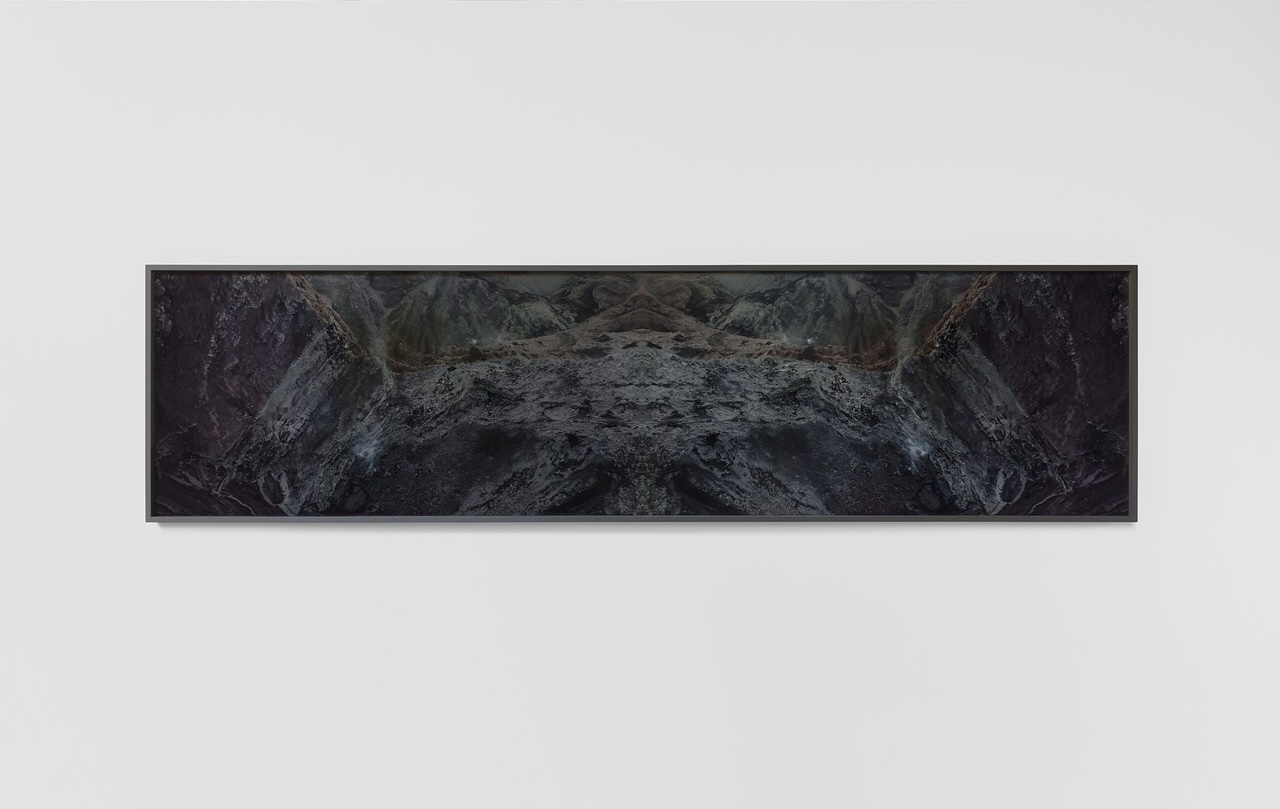
At its centre, the series Eye of Silence marshals high-altitude photographs of the Albertan Badlands, the Utah Salt Flats, Icelandic and Japanese volcanoes, and a meteorite crater in the Namibian desert. Visualising the Earth at critical moments in its evolution, the narrative begins by speculating about the moment when life on the planet was seeded by a frozen meteorite. Continuing Stankievech’s pursuit of sounds beyond the human threshold is an ultrasonic sound
installation, What Is It Like to Be a Bat?. Using laboratory equipment to run the installation, the work proposes the possibility/
failure of a previously impossible mediation between species. In an attempt at trans-species communication, an Artificial Intelligence reads the classic philosophical essay by Thomas Nagel in a frequency only audible to bats. Visitors in the gallery can strain their attention hoping to hear something, possibly hallucinating like our ancestors in prehistoric caves who imagined a newly born consciousness that dissolves the boundaries between animal and human.
Finally a scientific model of a historically significant meteorite floats above a sand floor. The levitating artifact suspends the moment in time just before a cataclysmic collision that would fuse sand into glass upon impact. The Desert Turned to Glass
calls forth otherworldly experiences from within the depths and heights of this world, at the same time cultivating an aesthetic disposition to receive them.
Charles Stankievech is an artist redefining “fieldwork” at the convergence of geopolitics, deep ecologies, and sonic resonances. From the Arctic’s northernmost settlement to the depths of the Pacific Ocean, Stankievech’s practice uncovers the paradoxes of our existence on the planet by engaging with the imperceptible.
His diverse body of work has been shown internationally at institutions including the Louisiana Museum of Modern Art, Copenhagen; Palais de Tokyo, Paris; Haus der Kulturen der Welt, Berlin; National Gallery of Canada, Ottawa; Thyssen-
Bornemisza Art Contemporary, Vienna; MASS MoCA; Musée d’art contemporain de Montréal; Canadian Centre for Architecture, Montreal; and several biennials from Venice to SITE Santa Fe. He has been an editor of the peer-review Afterall Journal (U. of Chicago Press) since 2015 and was the co-founder/director of K. Verlag Press, Berlin. From 2015-2021, he was Director of Visual Studies, where he is currently an Associate Professor in the Faculty of Architecture, Landscape and Design at the University of Toronto. In 2022-23, he was also a visiting research professor in the Department of Architecture at the University of Tokyo.